Four weeks, twelve builds, one system that answered back.
Eric Fleshman was one of 50 builders selected from more than 1,000 applicants for AlphaForge Cohort 2: four weeks, twelve shipped builds, graded on working systems. This page is the record of that arc, from the first warmup build to the outbound loop that closed on a real buyer reply.
from 1,000+ applicants
Selected, then picked twice
AlphaForge is Clay's GTM engineering program. Cohort 2 took 50 builders out of a pool north of a thousand, put them on a four-week shipping cadence, and graded on working systems rather than slide decks. At graduation the coaching staff handed out awards. Eric came out of it with the coaches' pick and a paper plate.
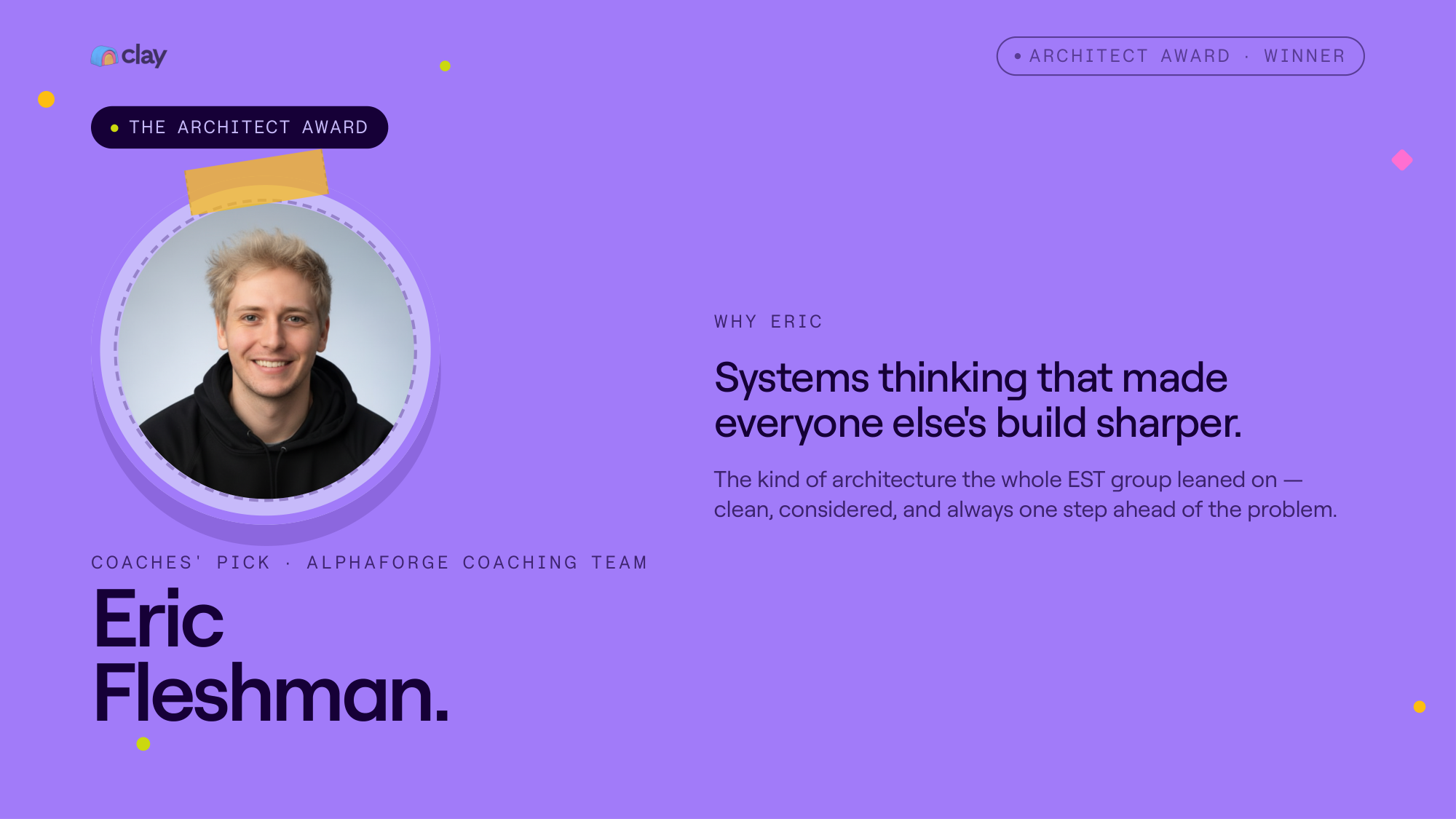
"Systems thinking that made everyone else's build sharper." Selected by the AlphaForge coaching team after what the deck called a frankly heated debate.
The reveal: "For the builder whose systems thinking made everyone else's work better." And the winner is... Eric.
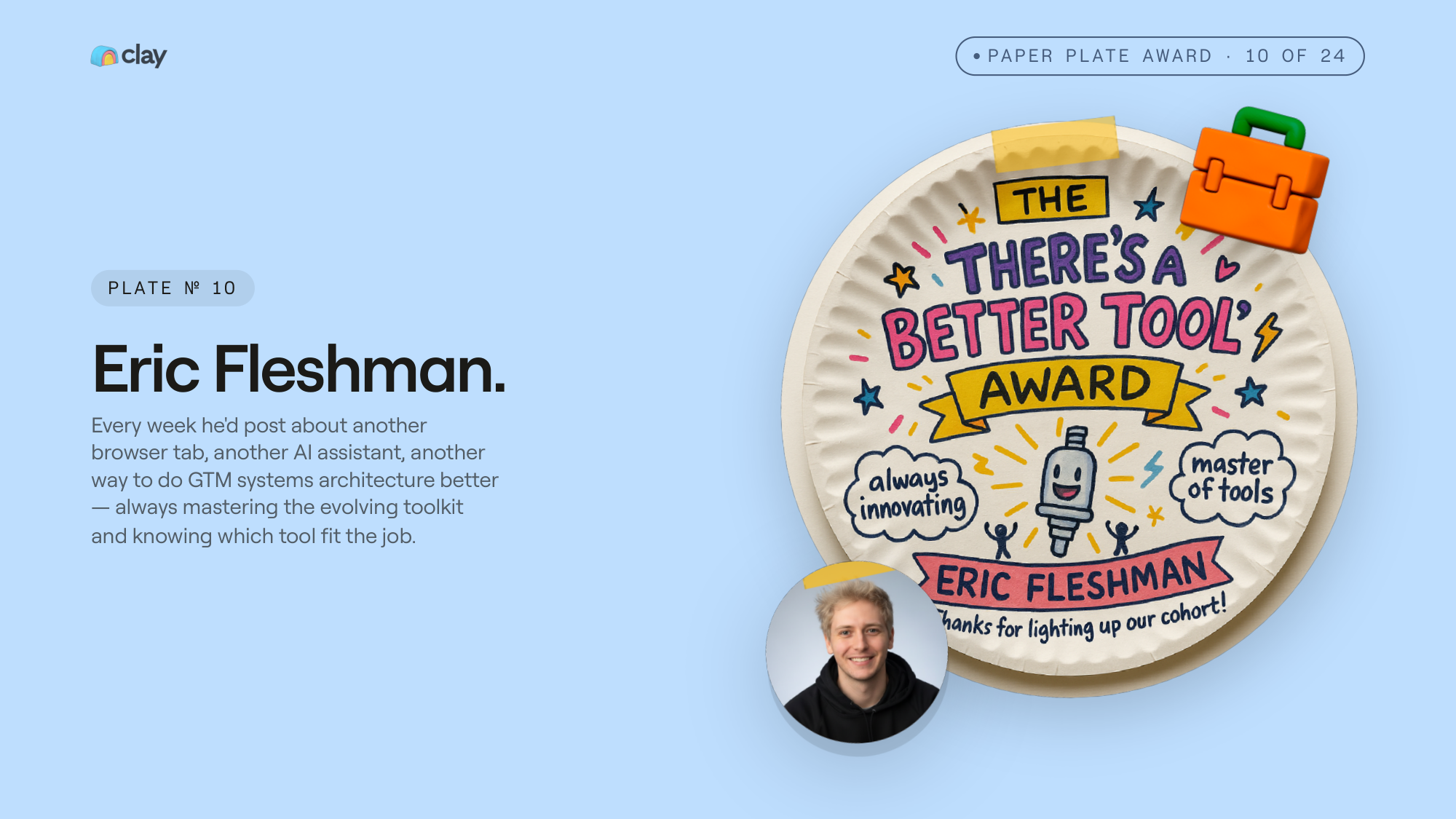
The "There's a Better Tool" Award. "Every week he'd post about another browser tab, another AI assistant, always knowing which tool fit the job."
The Caterpillar build, end to end
The centerpiece, assembled layer by layer across the middle weeks of the cohort, was an outbound system built for a heavy-equipment go-to-market: find US heavy-civil contractors at a real commercial moment, disqualify everything that only looks like a buyer, and send something a real company's reputation can stand behind. A raw construction TAM is not a market. Dealers, design-only firms, and trade media all show up in the same list as the people who actually buy and rent machines.
So the system was built gate-first. Signal arrives, a gate decides whether it deserves human attention, and only what passes gets enriched, drafted, and sent. The measure of the build was never the diagram. It was whether the loop would close on a stranger.
Signal in, reply back
Clay to n8n to Gmail to watcher, back into Clay-
01Signal in
A trigger event lands: a public award or permit filing that says a contractor just took on work. An n8n watcher polls public federal award data (the USASpending API) daily with stable dedupe, so the same award never enters the pipe twice. The proof run entered on a real one: McCarthy Building Companies and a $220M I-70 corridor award.
-
02ICP Fit Gate
The gate scores the signal and writes down why. It runs on disqualification logic first: dealers, design-only firms, and media get rejected before anything expensive happens. What survived across the full sweep was a qualified TAM of 631 US heavy-civil contractors. Every verdict carries its reasoning, so a bad call is debuggable instead of mysterious.
-
03Enrich
Only accounts that cleared the gate get enriched: firmographics, the equipment and operations roles that actually decide rent versus own, and the public award evidence that justified the reach-out in the first place. Across the proof cohort that meant 46 named decision-makers, 40 of them with verified work emails.
-
04Engage
Drafts are personalized off the enriched evidence, then pass a human approval gate before the n8n send engine hands them to Gmail. Twenty-five approved sends, twenty-four delivered.
-
05The loop answered back
A real reply came back from Traylor Bros, a top ENR heavy-civil contractor. Not an out-of-office and not a bounce: an equipment leader who walked through exactly how his team decides rent versus own. This is the proof point. Every box above it is a claim until a stranger answers.
-
06The RE: bug, caught live
That reply almost never registered. The watcher filtered case-sensitively for one spelling of the reply prefix, and Gmail delivered another. The loop silently dropped the only thing it existed to catch. The fix was a case-insensitive filter, republished; the next poll picked the reply up automatically and pushed it back into Clay.
filter: "Re:" becomes /^re:/i // found in production, fixed live
Reply written back into Clay. Loop closed.
The ethics moment
Every draft carried a value line offering an "anonymized 600-contractor study" that did not exist. It got cut before sending and replaced with something true. "Offer value" is not a line you add to an email. It has to be true before you hit send.
What the build proved
- A gate with written reasoning beats a score with none.
- Disqualification logic is cheaper than enrichment.
- A human approval gate is part of the system, not overhead on it.
- A loop is only closed once you have watched it close.
What it deliberately did not do
- No sending without a human approving the draft.
- No claims in copy that could not be backed up.
- No enrichment spend on accounts the gate rejected.
- No silent failures: a dropped reply had to be findable.
Coach's read. "The fullest loop I've seen." The system was not the most complicated one in the cohort. It was the one where signal, gate, enrichment, send, and reply were all wired to the same circuit, so a real answer had somewhere to land.
All twelve builds
Four weeks, one build shipped at a time, each one a working system rather than a plan for one. The foundations set the writing and thinking standard, the middle builds assembled the Caterpillar system layer by layer, P9 put real emails in real inboxes, and the final week turned the work into public artifacts.
Foundations
- WOrigin storyThe honest narrative: why marketing-to-GTM-engineering, written before any table existed.
- P1Nobody Wants the Tool That Tells the TruthShip an assertion, not an insight. The writing standard every later build was graded against.
- P2Teaching Is KnowingPublished as "The AI Agent Is the Smallest Part of the System." The harness thesis, early.
The system, layer by layer
- P3Your First BuildAn accounting-firm FETE table (Find, Enrich, Tier, Engage). Shipped as a build log titled "The Build Broke at Step 1," because iteration is the point.
- P4Audiences"Stop Selling Excavators to Architecture Firms." The Caterpillar ICP and a 5-layer audience architecture.
- P5Signals & IntentLive news and fundraising signals layered onto the audience, with recency and confidence gates over raw signal dumps.
- P6Make It ReusableThe published ICP Fit Gate function plus a live federal-data webhook leg. Built the evening of July 4.
- P7TAM631 qualified heavy-civil contractors, and a silent payload bug found and documented on the way.
- P8Segment StrategicallyTrigger-based segments (Owner-Led, Sales-Led, Enterprise) defended against a lazy size-based cut.
The loop closes
- P9Make It FireThe live send: 25 approved, 24 delivered, one real buyer reply. The RE: filter bug found and fixed in production.
Positioning and public artifacts
- P10Pick Your WedgeThe positioning brief. "I don't manage, I ship."
- P11Make It YoursThis website. "My portfolio prospects you back."
- P12Teach It ForwardAgent Anatomy, the public teardown of a production coding agent.
// Numbering and titles are the cohort's own prompt sequence, Cohort 2, June to July 2026.
What traveled past graduation
Most cohort work stops being useful the day the cohort ends. Two pieces of this one did not, because they were built as components rather than as demos.
The ICP Fit Gate
Built for one heavy-civil TAM, but the input is a plain-English ICP and the output is a verdict with its reasoning attached. That signature is what made it portable: point it at a different market, hand it a different ICP, and the disqualification-first logic still holds.
It is now the reusable component in front of anything that costs money to enrich or credibility to send.
The workspace reorg
Mid-cohort, the project workspace stopped being navigable. Twelve builds in four weeks generates tables, views, and workflows faster than any naming convention survives by accident.
The reorg was a build in its own right: restructure the workspace so any single build could be found, re-run, and explained without its author in the room. Shipping speed after the reorg is the argument for it.